
100x
Faster than CPU CFD
Accelerate simulation turnaround so teams can test more design candidates per engineering cycle.
Product
Built on our proprietary FluxCore Architecture to streamline CFD and CHT simulations from automated geometry cleanup through high-fidelity results and large-scale data generation for Physics AI models. Its solvers are fully differentiable, enabling gradient-based design sensitivity and optimisation workflows.
100x
Accelerate simulation turnaround so teams can test more design candidates per engineering cycle.
Lower cost
Reduce reliance on physical prototyping and increase design throughput before committing to hardware.
Immediately scale to hundreds of GPUs
Run CFD capacity when it is needed, from individual validation studies to large data-generation campaigns.
CFD Workflow
Gradient Dynamics brings geometry preparation, GPU-native simulation, and AI-ready result generation into a single workflow. Fully differentiable solvers help engineering teams move from raw designs to credible fluid dynamics insight, sensitivity analysis, and optimisation with less friction.
A proprietary GPU-native CFD and thermal architecture built for high-throughput simulation, fully differentiable solvers, robust performance, and engineering-scale iteration.
Prepare complex CAD and engineering geometry for simulation with less manual repair, cleanup, and preprocessing overhead.
Generate high-fidelity CFD results at scale to support design studies, validation workflows, and training data for Physics AI models.
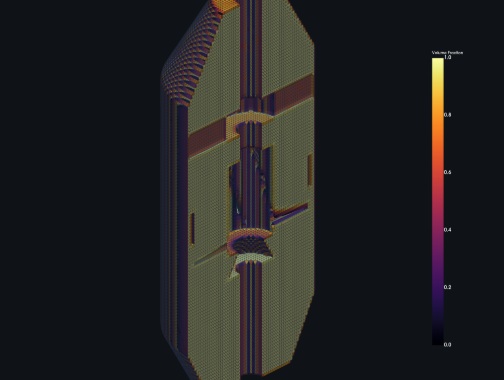
FluxCore-powered simulations support repeated design evaluation, coefficient tracking, pressure and velocity visualisation, and export into established CAE post-processing tools. The same workflow can also produce large simulation datasets for training and validating Physics AI models.